My blog has moved!

You will be automatically redirected to the new address. If that does not occur, visit
http://mashriq.mattityahu.com/
and update your bookmarks.

Showing posts with label Israel. Show all posts

Tuesday, July 12, 2011

Why I Am Against The Anti-Boycott Law

Today, the Knesset passed a law, 47-38, called "The Prohibition on Imposing a Boycott." (You can read the text of the bill here.) 

Now anyone who knows me or reads this blog will know that I am against boycotting Israel, Israeli institutions, companies, or anything else. They will also know that even though I am not a huge fan of the settlements, I am against boycotting them because it will have no effect on ending the occupation, among other reasons. 

Boycotts create the impression that replacing the occupation with peace is completely within Israel's control and would happen if only Israel agreed. Israel did this in 2005 when it withdrew from Gaza and the northern West Bank. It ended the occupation there but instead of replacing it with peace, it was met with continued and repeated rocket-fire. This is also what happened after Israel withdrew from south Lebanon in 2000. That is why it is the express policy of the State of Israel and the Quartet (the US, EU, UN, & Russia) to end the conflict only through negotiations.

Boycotting Israel will not end the occupation. Boycotting the settlements will not end the occupation. 
Only a peace treaty with the Palestinian Authority can end the occupation.

If I'm so against these boycotts, why am I against this new law?

Because it criminalizes thought.

I am against this law for the same reason that I am against a law that would criminalize flag-burning. 

The proper way to dispose of a soiled and irreparable flag is to burn it. That means that if you have two people burning a flag, one because he wants to honor the flag and one because he hates America, only the latter will be arrested. They have both done the same thing, but because of their thoughts, because of their intentions, only one will be arrested. Their action (flag-burning) isn't illegal, but their thoughts are.

That is what this new anti-boycott law does.

According to the new law, you can boycott Israeli companies and businesses, but not if you are doing so because they are Israeli.

A group can boycott the Ariel Cultural Center for any number of reasons, like not hiring enough minorities, putting on bad plays or any other reason, but not because it is a settlement.

Recently, there was an online campaign to boycott cottage-cheese until the manufacturers lowered the prices. The boycotters won! They got the manufacturers to back down and lower their prices. But if that exact same group, organized the same exact boycott but did it instead because the manufacturers were Israeli (which they are), under this new law, they would be fined. 

The boycott isn't illegal itself, it's the thoughts of the organizers that are.

The worst part about this law is that it equates the settlements with Israel itself. The settlement movement has finally gotten a law passed that achieves what they have been working on for years: official recognition that the only legitimate form of Zionism is Revisionist-Settler Zionism and all other forms not only aren't Zionist but are in fact anti-Zionist.

Am I overreacting? Perhaps a little. But if the High Court of Justice doesn't strike down this law, we should all be very worried about Israel's future as a Jewish and Democratic State because this brings it down the road to being neither.

Sunday, May 29, 2011

The 67 Lines Aren't Technically "Indefensible" but....

Jeffrey Goldberg had a good catch on the line about the "Israeli" blockade in the Times.

But in a previous posting, he wrote that the 1967 lines weren't indefensible because despite having them, Israel won the Six Day War. 

That isn't exactly the case.


In 1967 Israel made a pre-emptive strike, taking the fight to its enemies before they had a chance to attack Israel itself. It was because of this quick action that Israel won and the 67 lines didn't prove to be a problem. However, in 1973, when Israel failed to act preemptively, it was attacked and took nearly a month to fight off Egypt, Syria and Iraq. Israel was able to absorb the attacks because most of the fighting was done in the Sinai and the Golan, not in Israel proper. Had the 67 lines still been Israel's borders, there would have been no margine for error and while it is possible Israel still could have won, it would have been at a much higher cost in lives (not to mention that Jordan would have most likely joined in as well).

The 67 lines aren't technically indefensible (especially if they are accompanied by a region-wide peace treaty) but they do make it much more difficult for Israel to second guess itself. 

It's like the situation with Iran; Israel doesn't have the luxury of being wrong on this issue, which is why so many people think Israel will eventually try to destroy its nuclear program militarily. If Israel were to return to the 67 lines, the IDF would always be on a hair-trigger, just in case something changed, which could lead to Israel into needless preemptive action, upending a peace agreement and sending us back in time.

Friday, May 13, 2011

Israel and the Arab Spring

Ever since the Arab Spring made its way to Syria, there have been many people, both politicians and bloggers (I actually really like this blogger, I just wish she liked Israel a little more, or at all), who have been asserting that Israel does not want to see a truly democratic Syria. What's more, they have claimed that Israel is actively lobbying Washington not to abandon Assad or side with the protestors.

It was in this context that Israeli Foreign Minister Avigdor Lieberman openly lamented the lack of Western pressure on both Syria and Iran. He essentially called on NATO to actively intervene and support the protesters in both countries as it is doing in Libya.

Now, one can make the claim that the minister is only saying this cover Israel's tracks or he is simply trying to gain sympathy points by calling for something he knows won't happen. But I disagree.

It won't surprise any of my readers to hear that I am no big fan of Lieberman, but on this case I agree with him and I take him at his word. The West should be supporting homegrown pro-democracy movements in the Arab world and Iran (and everywhere else for that matter).

Why?

Because democracies, however antagonistic, don't fight each other.

Because Israel now sees that the peace treaties it made with the dictators of Egypt and Jordan are inherently flawed since they are not shared by their people.

Because in order to have real peace with its Arab neighbors, their governments must be truly representative of their people.

Because democracy is the right of all people and supporting it should be a goal in and of itself.

Israel made the mistake of maintaining its support for Mubarak up to the end and is not likely to make the same mistake again so soon. Especially not for someone who has refused to make peace at every turn, who actively arms and trains Hezbollah, and who arms and shelters Hamas. This is not a someone Israel needs or wants in power.

The people want the downfall of the regime!

Wednesday, May 4, 2011

Hamas' Two State Solution

Hamas head Khaled Meshal recently celebrated the new Palestinian Unity Agreement by giving a speech in which he said: 


"We will have one authority and one decision. We need to achieve the common goal: a Palestinian state with full sovereignty on the 1967 borders with Jerusalem as the capital, no settlers, and we will not give up the right of return."


He should have been a little more specific. When he said "no settlers" he meant no Israeli settlers. Palestinian settlers on the other hand are an absolute necessity. 


Khaled Meshal


Let's put this in perspective: under any peace deal, only a few thousand Israeli settlers would remain in a Palestinian state and at the very most 50,000 would decide to remain. That is 50,000 Jews among among roughly 2.5 million Palestinians. That would make Jews 2% of the West Bank and only 1.25% of the entire State of Palestine since there are no Jews left in Gaza. 


Now let's put that in a political context: to gain 1 seat in the Israeli Parliament - the Knesset - a party must win at least 2% of the vote. If Palestine were to adopt a similar law which is common in Parliamentary democracies (and should the State of Palestine actually become a democracy) even if every Jew voted for the same party (which is extremely unlikely to begin with) they would not even be able to get a single representative in the Palestinian Parliament.


Settlers pose no threat to demographic dominance of the Palestinians in their own state. Even if every settler were to stay in the new state, they would only be 17% of the population. This is much less than the current 20.4% of the Israeli population that is Palestinian, and that is before any Palestinian "refugees" are allowed to "return." After a few million Palestinians move to Israel, they would quickly become the majority, turning Israel into a de facto second Palestinian state.


This makes one wonder, when Meshal says he wants "a Palestinian state with full sovereignty on the 1967 borders," which side of those borders does it want to be on? 


Meshal's idea of a two state solution is not one of Israel and Palestine, it is a Fatah State in the West Bank and a Hamas State in Israel and Gaza.

Tuesday, May 3, 2011

Hamas and Bin Laden

As I'm sure anyone reading this knows, on Sunday, President Obama announced that the US finally killed Osama Bin Laden. This was immediately followed by celebration around the world; at least it was in most circles.

It may be unseemly to rejoice in the death of a human being and normally I would not engage in this and would encourage others refrain from celebrating death, but I can't in this instance. There are some people in this world who are so evil, who's sole mission in life is to bring death to others, that the only logical response to their own demise is to rejoice and be glad that the world is rid of them. Osama bin Muhammad bin Awad bin Laden was one of those people and I can only say that news of his death brought me nothing but joy.

This feeling was not shared by everyone. Hamas released a statement condemning the US operation, claiming it was:

"a continuation of the American policy based on oppression and the shedding of Muslim and Arab blood... We condemn any killing of a holy warrior or of a Muslim and Arab person and we ask God to bestow his mercy upon him."

And for some reason the world was shocked by this. The US can't seem to understand. The EU is baffled. William Hague, Britain's Foreign Secretary had this to say:


"It would have been better for Hamas to join the welcome to [bin Laden's death]. That would have been a boost in itself to the peace process."


And you know what? He's right. It would have been better for Hamas to welcome bin Laden's death. It would be a boost to the peace process. But the fact of the matter is that Hamas did not. 

Why?

Because Hamas loved Osama bin Laden. They shared the same ideology, the same tactics and the same virulent hatred of Jews (bin Laden was less reluctant than his friends at Hamas about talking plainly of his anti-Semitism, he didn't bother couching this hatred with the more "acceptable" anti-Zionism or anti-Israelism). Bin Laden often spoke of himself as leading his crusade against the West as part of his fight to "liberate Palestine" from the Jews.

On September 11, 2001 Hamas was out on the streets of the West Bank and Gaza celebrating and handing out candy to children. 


They rejoiced at the news of American civilians being massacred in New York and Washington. They celebrated and glorified Osama bin Laden as a hero. Their reaction to news of his death should surprise no one. And yet it has.

Why?

Because for too long people have made excuses for Hamas. For too long people have been saying they don't really mean what they say. That they don't really hate Jews, they just hate Israel for the Occupation. They don't really want to kill civilians they have no choice. They would welcome peace if only we spoke to them and heard them out.

I learned long ago that leopards don't change their spots and if you shave their fur, you'll see their spots are even on their skin.

Hamas' hatred of Jews and Israel is not superficial or something used to grab attention or followers. It is a part of their ideology and goes to the core of their belief system, one that they have anchored with God. This cannot be changed or shed, so it should not be ignored either.

Yes Mr. Hague, it would have been better for Hamas to welcome bin Laden's death. Yes Mr. Hague, it would have been a boost to the peace process. But no Mr. Hague, that is not what happened. No Mr. Hague that is not who they are, that is not what they believe.

This is an organization that grew out of the Egyptian Muslim Brotherhood, based itself on the teachings of Sayyid Qutb and Hassan al-Banna, that uses violences to kill Westerners and Muslims who oppose them, that has recruited suicide bombers from Britain itself and has called on its followers to kill Jews and Americans.

Anyone hearing this description would immediately think I am describing al-Qaeda, but I am in fact talking about Hamas. They are one in the same. Just as there is an al-Qaeda in Iraq, the Arabian Peninsula and the Maghreb, there is an al-Qaeda in Gaza. It just happens to have a more specific focus.

The civilized world rejoiced and congratulated America on killing bin Laden, but they condemned Israel for killing Ahmed Yassin, the founder and spiritual head of Hamas. Should Israel ever be so lucky to kill Haniyeh or Meshal of Hamas, Hassan Nasrallah of Hezbollah, or Ramadan Shallah of Islamic Jihad, we can expect a similar response.

The lesson for Islamists is clear: Kill as many Jews as you want, just make sure you stay out of America.

Sunday, May 1, 2011

Mashriq Matt Solves the Israeli-Palestinian Conflict

Ok, this one is a little long, but with a title like the above, it couldn't be short. So please be patient, keep reading and I think you may be a little surprised. If these ideas have been proposed before, I certainly haven't heard of them. 

One of the problems with the Israeli Peace Initiative and every other peace plan with the Palestinians, is that they don't recognize the inherent difference that they have from those made with Egypt, Jordan and Mauritania. The reason why negotiations with the Palestinians are so different is that they aren't just negotiating a peace treaty, but the Palestinians are negotiating their way into existence as a state. This means that even before talks begin, there is an inherent disparity between the two parties. So, should the Palestinians declare statehood in September as they have threatened to do, this does not necessarily mean it will be bad for Israel and in fact, it could even be good if it allows the Palestinians to negotiate from a better, more equitable place.

This would put Israel and Palestine on more equal footing. The Palestinian Declaration of Independence of 1988 is based on its Israeli counterpart. The Israeli and Palestinian peoples are inseparably linked and by creating parity and reciprocity between the sides, it may be easier for each to accept compromises as they see their enemies doing the same. It is for this reason that obligations should be carried out simultaneously and not one after the other.

By allowing the Palestinians to declare independence prior to the signing of a peace treaty, Israel would take much of the pressure off Palestinian leaders who are constantly afraid of compromising too much and giving up too much at the beginning. If they are already independent, they will have more latitude for movement. Many people are afraid that this will hurt Israel but the fact of the matter is that any declaration of Palestinian independence would be largely symbolic and have little effect on day to day activities. Israel would not automatically pull out of the West Bank, so there would be no vacuum of power for Hamas to run in and fill. People often forget that the Palestinians already declared independence in 1988 during the first intifada and since then this has been recognized by over a hundred countries and yet it has done nothing to change the situation. Such a declaration will only bring about change should Israel recognize it and allow for the Palestinian Authority to take on more responsibilities. Then the PA leaders could talk with Israeli negotiators as equals, giving them more legitimacy and therefore the ability to make the hard decisions they were previously afraid to make.

The main issue that the parties keep running into is defining the borders of the new State of Palestine. The Palestinians keep saying they need the '67 borders and have convinced the whole world that before the Six Day War, these were the borders of a Palestinian State (which of course isn't the case, but that is a discussion for a different time), while the Israelis keep on saying that the new state should have provisional or intermediate borders. But the Palestinians are worried that any temporary borders would eventually become permanent. And they have good reason to be worried since that is exactly what happened to Israel and Israel is still trying to define it's borders 63 years after its creation. For this reason, there should be no discussion of the borders of a Palestinian state. When Israel declared independence, the leaders made no reference to the new state's borders, Abbas and Fayyad should follow this model.

Many people say that a unilateral declaration of independence by the Palestinians would bring more pressure on Israel since it would then be occupying an sovereign state. But they fail to recognize that that is happening anyway and will be sure to continue until an agreement or an end to the occupation comes. Also, occupation of another state is not illegal (if there is cause). Israel itself was occupied by Arab forces when Ben Gurion declared independence in 1948, so it seems somewhat fitting, or ironic (take your pick) that Israel should be occupying Palestine when it finally declares independence.

The Right of Return is another incredibly sticky issue. The Palestinians say that excluding it is a non-starter and the Israelis say including it is a non-starter. Even President Obama is making his own peace plan, but one of the key components (not surprisingly considering America's close relationship with Israel) is no right of return. So how exactly can you have the Right of Return but also not have the Right of Return? This requires some fancy maneuvering in which Israel recognizes the Palestinian Right of Return, agrees to resettle hundreds of thousands of Palestinians in Israel, but at the same time not accept more Palestinians into Israel which would pose a serious threat to Israel as a Jewish and Democratic state. These may seem like contradictory and irreconcilable positions, but they are not.

After 1967, Israel began a policy of granting citizenship to foreign Palestinians through family reunification laws. Through this policy, from 1967 to 2001 over 250,000 Palestinians moved to Israel and gained Israeli citizenship. Let me repeat that: over a period of 34 years, during which Israel engaged in 3 wars with Arab states and 2 Palestinian intifadas, Israel granted citizenship to over a quarter of a million Palestinians! Nearly 100,000 Palestinians became Israeli citizens in the 1990s alone! Instead of focusing on the fact that no other state in the history of the world has welcomed as equal citizens members of an enemy nation in such incredible numbers, we should see this as a unique way out of the Right of Return issue. The generally accepted number of Palestinian refugees created in 1948 is 750,000, and taking this as a guide, Israel has already allowed at least a third of the number of the original refugees back to Israel.

Israel can therefore recognize the Palestinian Right of Return, apologize for its part in creating the refugee crisis and agree to take in a quarter of a million refugees (the Arab League should also agree to take in and grant citizenship to other refugees, while admitting their role in creating and perpetuating the refugee crisis) and then Israel can say that it has already fulfilled this obligation but as a gesture of goodwill will accept in a few thousand more (specific number to be determined later) over a period of ten years. In this way the Palestinians can claim victory in getting hundreds of thousands of Palestinians to return to Israel, but Israel doesn't actually have to take in any new Palestinians.

In the spirit of parity, the Palestinians should agree to recognize the Israeli Right of Return to Israel and the West Bank. It is accepted that most Israelis living in settlements will be annexed to Israel, however, not every settlement will be able to be annexed and the Israelis living these isolated settlements might not want to leave. These numbers will be significantly smaller than those Palestinians who have been accepted into Israel and they pose no demographic threat to the Palestinian people due to their extremely limited number (now Israeli Arabs make up 20% of Israel's population, but the only way Palestinian Jews would be able to even come close to those kind of numbers would be if every settler was granted Palestinian citizenship).

It still surprises me that everyone recognizes that Israel must stop building settlements in the West Bank, but when the Palestinians insist on building settlements in Israel AFTER a peace deal is signed - in the form of the Right of Return - those same people see no problem. After all, what is the purpose of creating a Palestinian State if Palestinians are going to move to Israel instead? Not even Israel is insisting on the right to build settlements in a future Palestinian State (though it easily could as I have shown), so why do the Palestinians keep insisting on the same thing? Just as Jews will need to give up on their Right of Return to Judea and Samaria (the West Bank), so too do the Palestinians need to give up on their Right of Return to Israel proper.

I am not bringing up a Jewish Right of Return to add another problem that needs to be solved. So why bother? Because the Palestinians need to recognize that Israel is also giving up on something extremely important. Giving up the West Bank is not merely the ceding of a piece of real estate; it is the birthplace and heart of Judaism and Jewish history. By relinquishing control of the West Bank, Israel is compromising on its birthright and on the central precept of Zionism that preached a return of the Jewish people to the land where the Israelite Nation was born. If Israel is willing to make such a difficult and impossible compromise, the Palestinians should agree to make similar compromises. This recognition of the suffering and rights of the other is an important component of a successful peace agreement.

Of course all of this will require some major good faith by both sides, which is always in short supply. Additionally, should the reconciliation agreement between Fatah and Hamas actually hold, all of this will be more difficult if not impossible given Hamas' open and consistent calls for the complete destruction of Israel. Only time will tell what this agreement will come to, if anything at all, and just because I have said a declaration of Palestinian Independence could move negotiations one way does not mean that will certainly happen. Only that it is plausible, logical, and our best hope.

Wednesday, April 6, 2011

The Israeli Peace Initiative

A new peace initiative was released today by former Mossad and Shin Bet Chiefs, IDF General and MKs. It is designed to be a response to the Arab Peace Initiative of 2002 and is intended to prode Netanyahu into action before a possible vote on Palestinian Statehood in the UNGA in September.


The Israeli Peace Initiative (as it is referred to) is both bold and vague, addressing not just the Israeli-Palestinian conflict, but the conflicts with Syria and Lebanon as well. Granted, it is not supposed to be used as a final status agreement, but merely as a means by which to help all the parties involved reach such an agreement. The full text of the Initiative (sorry for the long sentences but that's how it was written in Hebrew and I wanted to remain as close to the original while translating) is below, but first a few of my observations:

  • The text refers to both Palestinian and Jewish refugees, though only discusses solutions for the former.
  • It talks of "an Israeli withdrawal" but does not say "complete" or "full," in the same manner in which UNSC Resolution 242 refers to a withdrawal "from territories" but not "from the or all territories."
  • Recognition of Israel as a Jewish State and Palestine as a Palestinian State is required.
  • An Arab minority is guaranteed "full equal civil rights" in Israel, but there is no mention of Jews in the Palestinian State or the rights they would enjoy.
  • Jerusalem is to be divided along Jewish-Arab lines, with Israel keeping the Jewish Quarter of the Old City but not the Temple Mount.
  • The Islamic Holy Places are to be under a "Muslim Waqf," but it doesn't say which one. It is currently under a Jordanian Waqf. Will Jordan transfer this to Palestine? Unclear.
  • The Right of Return can only be realized in a Palestinian State and the territories to be transfered to it by Israel. Only a symbolic number of refugees will be allowed into Israel.
  • "All elements in the region" are to be consulted in order to solve the refugee problem. The authors use the word "הגורמים" which can mean both "elements" (reference to Hamas?) or "responsible bodies/authorities" (reference to the Palestinian Authority since it isn't a state yet?) This needs to be clarified.
  • It discusses both Syria and Lebanon and talk of the Arab and Muslim countries but never mentions the Arab League or the Organization of the Islamic Conference by name or any specific obligations they might have.
The following is my own translation of the Israeli Peace Initiative:


The Israeli Peace Initiative
6 April 2011 - Proposal

The State of Israel
  • Declares that it is its strategic objective to obtain historic compromise leading to formal regional arrangements that would bring about an end to all claims and conflicts, achieve peace, security, economic growth in the Middle East, and fully normalized relations between Israel and all Arab and Islamic countries.
  • Recognizes the suffering of the Palestinian refugees from 1948 and the suffering of the Jewish refugees from Arab countries, and recognizes the need to solve the problem of the Palestinian refugees by mutual agreement and realistic solutions.
  • Believes that cooperation between all sides is vital to ensure that the Middle East enjoys economic prosperity, high environmental quality and a future of prosperity and welfare for all peoples.
  • Appreciates the Arab Peace Initiative of March 2002 as a historic step by the Arab countries to achieve a breakthrough and make progress on a regional level, and offers this as a partner declaration since “a military solution to the conflict will not achieve peace nor guarantee security for all parties.”

Therefore, Israel accepts the Arab Peace Initiative as a framework for regional peace negotiations, and offers the Israeli Peace Initiative as a response, outlining Israel’s vision of final status arrangements, which will be achieved through negotiations with the representatives of Arab countries, the Palestinians and Israel based on the following principles:

1.    The Principle of Ending All Conflicts
The founding principle of a permanent settlement in the region is an Israeli withdrawal, security arrangements, normal relations and an end to all conflicts, taking the security considerations of all parties into account, including the challenges of water resources, demographic realities on the ground, and the special needs of the three great religions. In addition, the Israeli-Palestinian conflict will be solved on the basis of Two States for Two Peoples: a State of Palestine as the nation-state of the Palestinian people and the State of Israel as the nation-state of the Jews (within which there is an Arab minority who will have full equal civil rights as outlined in Israel’s Declaration of Independence). Based on these principles, Israel offers the following vision:
1A - Permanent-Status Parameters to Settle the Israeli-Palestinian Issue
1. A Palestinian State – A sovereign, viable, and independent Palestinian State will be established in the West Bank and Gaza Strip from which Israel will withdraw. The Palestinian State will be demilitarized with full rights and responsibilities for internal security forces. The international community will play an active roll in ensuring the security of the borders and in fighting terrorist threats.
2. Borders – The borders of Palestine will be based on the lines of 4 June 1967 with agreed upon alterations based on the following principles: creating territorial contiguity between the parts of the Palestinian state; land swaps on the ratio of 1:1 (which will not exceed more than 7% of the West Bank) with an area (to be determined according to the precise needs) to create a safe passageway between the West Bank and Gaza Strip which will be under de-facto Palestinian control.
3. Jerusalem – The Jerusalem area will include the two capitals of the two states. The line will be drawn in the following way: The Jewish neighborhoods will be under Israeli sovereignty; the Arab neighborhoods will be under Palestinian sovereignty; special arrangements will be introduced for the Old City, which will ensure inter alia that the Western Wall and Jewish Quarter will be under Israeli sovereignty; The Temple Mount will remain without any sovereignty (or “Under God’s Sovereignty”), additional special arrangements will be introduced in regards to Islamic Holy Places to be run by the Muslim Waqf, and the Jewish Holy Places or Interests will be run by Israel, and an Israeli-International monitoring committee will be established in order to realize these arrangements.
4. Refugees – Resolving the refugee issue will be achieved by mutual agreement between all elements in the region based on the following principles: a financial compensation package will be offered by the international community and Israel for refugees in the countries where they are residing; refugees who choose to return to their homes (as specified in UN resolution 194) could return only to the territories of the Palestinian State, except for a symbolic amount to be agreed upon.
1B - Permanent-Status Parameters to Settle the Israeli-Syrian Issue
1. Borders – Israel will withdraw from the Golan Heights and return to a border based on that from 4 June 1967 with adjustments, to be agreed upon, on a limited scale and territorial exchange ratio of 1:1, which will reflect the international border of 1923. The mutual agreement will be implemented in a number of phases, similar to the model applied in the Sinai, and for a time period not to exceed 5 years.
2. Security Arrangements – The sides will agree on a package of security arrangements, which will define (by mutual consent) the amount of land to be demilitarized on each side of the border and arrangements for the deployment of international peacekeeping forces.
1C - Permanent-Status Parameters to Settle the Israeli-Lebanese Issue
1. Borders – Israel and Lebanon will establish a permanent settlement based on Resolution 1701, under whose framework, Israel has already completed its withdrawal to the international border.
2. Lebanese Sovereignty – In addition to the full implementation of Resolution 1701, Lebanon will fully assert its sovereignty in its territory through the Lebanese Army.
1D – State of Peace
Each of the final status agreements that will be signed between Israel and the Palestinians, Israel and Syria, and Israel and Lebanon, the parties will implement the instructions of the United Nations Charter and the principles of International Law that govern relations between states in peacetime; they will resolve all disputes by peaceful means; they will develop good, neighborly relations of coordinating bodies in order to ensure sustainable security; they will refrain from threats or the use of force against one another, refrain from joining a coalition, organization or alliance of any kind that has military or security nature, involving a third party, whose goals or activities include aggression or other acts of military hostility against the other side.
2.    The Principle of Creating Regional Security
1.     The parties will establish regional security mechanisms for dealing with common dangers and threats from states, terrorist organizations, pirate gangs and guerrilla organizations, in order to ensure the peace and security of all nations in the region.
2.     The parties will establish regional frameworks of cooperation for fighting crime and dealing with environmental dangers.
3.    The Principle of Open Economic Cooperation Across the Region
Through extensive financial assistance from the international community, the parties will implement broad cooperative projects to ensure the stability, vitality, and prosperity of the region, and achieve the maximum utilization of energy and water resources for the benefit of all parties. These projects will contribute to improving transportation infrastructure, agriculture, industry, and regional tourism, which will help deal with rising unemployment in the region. In the future, the parties will work to establish a “Middle Eastern Economic Block” (which will invite all countries in the region to join), with the aim of achieving a special status for the Bloc with the European Union, the US and the entire international community.
4.    The Principle of Creating Normal Diplomatic Relations and Ties Across the Region
Israel, Arab lands and Islamic countries need to promote gradual steps towards the establishment of normal relations between them, in the spirit of the Arab Peace Initiative – steps which will start with the launch of peace negotiations, with will gradually deepen, expand, and upgrade to the level of full normal relations (including diplomatic relations, open borders and economic ties) with the signing of permanent-status agreements in parallel to their implementation.

Monday, March 28, 2011

Why does Israel Insist on Recognition as a Jewish State?

This may be one of the most misunderstood issues facing Israeli-Palestinian Peace. Most question this insistence by asking:

Why should it matter if the Palestinians recognize Israel as a Jewish State?

Is Israel just insecure?

Whether or not the Palestinians say Israel is a Jewish State should have any effect on peace, so why does Israel stick on this point?

With these as the base, most people then conclude that Israel raises this issue for two reasons: 1. To create another problem to prevent peace and 2. to make it impossible for the Palestinians to get the Right of Return.

In order to understand why this point is so important, and why these conclusions are false, we must first establish what "recognition" means.

In this context, recognition doesn't mean they want President Abbas to say in a speech that Israel is Jewish or to just sign a declaration to that effect (though that would be a good step).

Recognition means that the Palestinian Authority must change its education system and teach its children that Jews have a right to live in Israel.

But Matt, you're saying, if the PA does that, it's as though they are saying that they don't have a right to live in Palestine!

Not so. There is no legitimate reason why two peoples can't have a claim to the same land. The Palestinians don't need to renounce their own claim. They need to teach their children that Jews have just as much a right to live there as they do, no more, no less.

If the Palestinians don't agree to this recognition and a peace agreement is signed without these changes, the peace is doomed to fail. Why would the average Palestinian accept an agreement with a state they believe has no right to exist? If Palestinian children continue to be taught from childhood that Israel is a colonial usurper, forced on the Middle East by imperialist powers, it doesn't matter what their leaders agree to on paper, they will continue to fight against Israel. The Palestinians must confront their rejectionist narrative and accept Israel as a legitimate partner.

This also means that Israel should be required to recognize an eventual Palestinian State as the nation-state of the Palestinian people. Israel will have to confront its own narrative and teach its children that Palestinians do exist and have just as much right to a state as they do. There has already been progress on this front in Israel, however, so far this has been mostly in universities.

For peace to be strong and lasting, it must be between people not just governments. That is what the issue of recognition is all about.

Wednesday, February 23, 2011

David Cameron Speaks Truth to Arabs

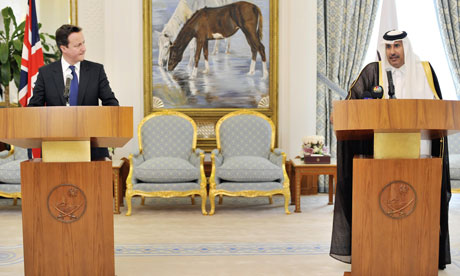
British PM David Cameron is rounding up a tour of the Middle East. He was the first head of state to visit post-Mubarak Egypt and he is currently in Qatar. At Qatar University he held a discussion with Qatari students and took questions on a number of issues ranging from the UK-Qatar relationship to the Arab Revolutions.

David Cameron with Qatari prime minister Hamad bin Jassim bin Jabr al-Thani on 23 February.


While addressing the prevalence of dictators in the Arab World, Cameron told the audience about the use of Israel as a distraction:

“In too many countries in the Middle East, some rulers say to their people ‘be angry about [Israel], don’t be angry about the fact that you live in a non-open society,"


This is not a revolutionary idea. It is in fact the reality in which the Arab World has been living for the past 63 years. However, the fact that PM Cameron said this directly to Arab students, in an Arab country, is very significant.


What is probably more significant however, is that the Gulf Times, the national newspaper of Qatar that is owned by Emir Khalifa ath-Thani, did not mention this important bit of information in its coverage of the event.

Cameron was quoted promoting democracy:

“I’m a democrat.  I believe in democracy.  I believe in freedom and human rights and I believe in the building blocks of democracy; a free society, an independent judiciary, the rights of free speech and free association,”


But when it came to his remarks on Israel being used as a scapegoat, something dictators were using to distract their populations from their own ineptitude, they were nowhere to be found.


So the Qatari royals don't mind Cameron promoting democracy as long as they can cover up his expose of their best weapon at containing it.


What wonderful Mashriq Madness!

Tuesday, February 8, 2011

El-Baradei on Peace with Israel

Muhammad El-Baradei was on "Meet the Press" this weekend and said something very important in regards to Egypt's Peace Treaty with Israel:


Egypt’s peace treaty with Israel is “rock solid,” Egyptian opposition leader Mohamed ElBaradei said on NBC’s “Meet the Press” program.
“I assume Egypt will continue to respect it,” ElBaradei said when asked about the current treaty. He also said “everyone in Egypt, everyone in the Arab world wants to see an independent Palestinian state.”
This should be very comforting to the many people who have been going on and on about how the Revolution will be the end of Egyptian-Israeli relations; that the peace treaty that has been in place for 30 years will come tumbling down with Mubarak.
Not this isn't a guarantee that it won't, but it is very encouraging. Most Egyptians still hate Israel and aren't happy about the peace treaty, but that doesn't mean they want to go to war either. And, even if they do, having a leadership that is pragmatic enough to recognize the consequences of rescinding the treaty could prove to be enough to keep it in place. Inshallah.

Mubarak's Reforms Rejected

Mubarak has been trying desperately to show the Revolutionaries in Tahrir that he understands their complaints and that he is willing to bring about the changes they demand. All of them, that is, except for the one that calls for him to step down immediately.

On the surface the reforms Mubarak is proposing are not insignificant and they are reforms the opposition has been demanding for years. They are:

  1. Lifting the restrictions on presidential candidates
  2. Liberalizing election controls (read: stop election rigging)
  3. Presidential Term Limits
  4. Increase press freedom

So why are these reforms now being rejected? Because the Revolutionaries see them as a stalling tactic. Even with all these reforms, Mubarak is still insisting on staying in power until the September elections. He has said he won't run for yet another term but that doesn't mean he isn't interested in hand-picking his successor.

The Egyptian People don't trust Mubarak and they have good reason. If they agree to the reforms and go home, they will lose the Revolution's momentum and when Mubarak reneges on his promises, it will be even harder to get people to come out and protest again.

Another issue is that Mubarak has made his new Vice President Omar Suleiman his main negotiator with the opposition. In addition to Suleiman being a life-long Mubarak loyalist, part and parcel to the government's repression of the people, WikiLeaks has released new papers detailing his close ties to the Israeli government. These documents are the perfect illustration of the problem with the Israeli-Egyptian Peace Treaty.

When two countries have peaceful relations, it should not be surprising that they cooperate, especially when dealing with groups considered to be an enemy by both states. The cables show the Egyptian government worked hand-in-hand with Israel in blockading Gaza. Hamas is a terrorist organization committed to the destruction of Israel and it is a direct offshoot of the Egyptian Muslim Brotherhood, which, though admittedly less violent (at the moment that is), wants to overthrow the Egyptian government (it has said it only wants to do so through non-violent means like elections, but I guess we'll have to wait and see). We can take some solace in the fact that unlike in the Palestinian Territories, the Muslim Brotherhood would most likely not come close to winning a democratic election. But it makes sense the Egyptian government, represented by Suleiman would want to do everything in its power to limited the Brotherhood's power and influence.

So why is Suleiman's "collusion" with Israel seen as such treachery? Because for the past 30 years Egypt has had peace with Israel on paper but been at with with Israel in its heart. Mubarak has not done anything to promote good relations, encourage tourism or even make minimal changes in the school curriculum that would teach Egyptian children that Israel is their friend and not their enemy. Israelis are still talked about as the enemy, Jews are represented in the State-run media as demons and child-killers and Zionist is probably the worst curse word you could call someone. 

But the biggest reason why these "revelations" about Egyptian-Israeli cooperation are so shocking, is that Egypt has been pretending to be the champion of Palestinian rights for more than 60 years now. The Egyptian government has been telling its people that it has been working on behalf of the Palestinians, fighting Israel for them and later lobbying Israel for them but never, ever working with them. Allah Forbid! When in fact the reality has been very different.
  • Creation of the Palestinian State wasn't even on the agenda for Egypt in 1948, it invaded Israel in an attempt to conquer the Negev and create a landbridge between Arab North Africa and the rest of the Mashriq
  • While occupying the Gaza Strip from 1947 to 1967, Egypt trained Palestinian Guerillas to attack Israel while keeping them under military occupation themselves. There were no moves towards Palestinian self-determination
  • Again in 1967 and 1973 Palestinian self-determination was not a real goal
  • For the past 30 years, Egypt has raised the Palestinian issue with Israel, but done very little to actually bring about a change in policy

Given the incredibly contradictory nature Egyptian rhetoric and actions, it is no surprise that the Egyptian people would be angry. Though to say that they are surprised their government doesn't practice what it preaches I think is a little much. They didn't trust the government to begin with, but it seems like the Palestinian issue is the one area that is held as sacrosanct. "Even Mubarak the oppressor wouldn't sell-out the Palestinians completely," was the thinking. But when the conversation is framed by the idea that having close relations with Israel is viewed as "selling out," then the cause of peace has already lost. 

Until major reforms are made in the minds of the Egyptian people, the peace will remain cold and shaky. It is possible that a peace treaty with the Palestinians could ease the tension, but it isn't guaranteed. Whoever comes to power in post-Revolutionary Egypt must reform the Egyptian attitude towards Israel and not just Egyptian government.

Friday, February 4, 2011

Right-Wing Fears

Ever since the Egyptian Revolution of 2011 began last week, there have been many right-wingers who have been bemoaning the loss of a crucial American and Western Ally. They have been ranting that Mubarak's departure will bring about a coup by the Muslim Brotherhood and signal the end of American influence in the Middle East as our other allies either fall victim to their own revolutions or distance themselves from the US before we can abandon them ourselves.


These views were repeated today by Sima Kadmon of Yediot Ahronot in her Op-ed The American Betrayal.


Her first point is that President Obama is a political amateur, willing to abandon America's allies without taking into account history or culture. She then takes this to the "logical" conclusion that America will abandon Israel if that is the way the political waves shift. While ignoring her repetition of right-wing theories about Obama's credentials, the idea that the American shift in favor of the Revolutionaries in Egypt somehow signals lack of American resolve or a "betrayal" is absolute hogwash.


She says:
"For dozens of years, he was the only leader the West could rely on, the dam in the face of Islamization."


Kadmon recognizes that the American relationship with Mubarak was based on his commitment to fighting Islamists and guarding the Peace Treaty with Israel. But those were the only real reasons for the "alliance." If it were not for these, there would be no reason to work with a dictator who summarily tortures, kills and jails his own citizens and does absolutely nothing to promote peace and understanding with Israel other than refrain for engaging in outright war.


Conversely, the American relationship with Israel is multifaceted and based on 60 years of close political, cultural, economic and military ties. These connections are bipartisan and are felt by the majority of the American population. The idea that this can just be thrown away is laughable.


Kadmon continues:
"And when America does this to the Egyptian president, what should any other ally think? Perhaps that it’s better to conduct oneself like Iran or Syria, rather than like a moderate Arab state."


This is a legitimate concern. How can our other authoritarian Arab allies know that we won't abandon them when their people rise up against them? 


They can't. American ties with Middle Eastern dictators are based on two factors: Oil and the War on Terror.


There was no deep and abiding American commitment to Egypt before the Revolution. The US took stock of the situation, recognized an opportunity to steal an ally away from the USSR and secure the first Arab-Israeli peace agreement. That was it and Mubarak knew it. 


Say what you want about Arab dictators (I have a few choice words myself) but they aren't stupid. King Abdullah of Saudi Arabia recognizes that without oil, his country has absolutely nothing to offer the US. That is why after 9/11 he ordered oil to be sold to America at a premium much lower than the market value.


As for Kadmon's assertion that it might be better for US allied Arab dictators to act like Iran or Syria, she may be right. But that would also mean international isolation and a loss of substantial US economic and military aid.


Kadmon asserts:
"it’s clear to all that if Muslim groups take power in Egypt at the conclusion of the uprising, our [Israel's] peace deal with Cairo is doomed."


I have written many times that the likelihood of a Muslim Brotherhood takeover of Egypt is very unlikely. That being said, there are a number of additional economic factors that would lead to the collapse of a Muslim Brotherhood led Egypt very quickly should that unlikely scenario occur.


  1. American Aid - Currently, Egypt gets $1.3 Billion (that's with a B) of aid from the United States every year. While most of this is military aid, the economic aid is significant as well. In order to maintain its role as the leader of the Arab world, Egypt can't just throw away that kind of money along with its ties to the leader of the Western world.
  2. Tourism - According to the BBC "The Egyptian government is keen to protect the tourism industry, which generated revenues of $11.6bn (£7.3bn) in 2009." With the Muslim Brotherhood in power and tourism will drop significantly, putting more people out of work, which is one of the main factors for why the Revolution has so many supporters.
  3. Oil - Much of Egyptian Oil resides in the Sinai desert but if the Muslim Brotherhood revokes the peace treaty with Israel, Israel will take back the Sinai by force (the deal was Land for Peace, if they take back the Peace, Israel will take back the land). Not only that, but Egyptian Oil and Natural Gas exports account for less than 1% and 2% of exports worldwide respectively. World investment will move to other, more stable countries without a huge effect on the market.
  4. Suez - Following an Israeli retaking of the Sinai, the Suez Canal - one of the largest and most used canals in the world - would be closed, just as it was between 1967 and 1979. If Egypt wants to continue to gain the revenue from running this important waterway - not to mention the prestige of owning it - it will need to keep the peace. Additionally, if Egypt wants to be able to export any of its remaining Oil (or any other products for that matter) to the Asian market without sending it all the way around the Cape of Good Hope, it will want to keep the peace to keep the canal open and working.
I must point out that all of these reasons are based on Western logic. However, the Middle East often operates on its own system of logic that is, well, illogical. It could come to pass that the Egyptian people make decisions that go directly against their best interests. 

Let's pray that cooler, wiser and more logical heads prevail.

Thursday, February 3, 2011

Mubarak Finally Plays the Jew Card

Mubarak is quickly running out of options. He tried saying he wouldn't run for president again. He tried firing his old cabinet and appointing a new one. He tried to claim that the protesters were really just lawbreakers intent on chaos. None of it has worked.

But in the Arab world there is one scapegoat that has never failed to increase people's capacity to believe in ridiculous conspiracy theories or suspend their grasp on reality: Jews.

Today, a young Egyptian woman has "come forward" to discuss how she was brought to Qatar by "Israelis and Jews" to learn how to bring down a government. The organization that she claims brainwashed her and other gullible Egyptians? Freedom House.

Yeah, right.

According to the article:
"after her initial recruitment, she was sent to Doha in Qatar with a group of other young people... "We received intensive training for four days. The trainers had different citizenships but a predominant number among them were Israelis," she said.

At the end of the interview the woman was asked what led her to confess her secret activities. At this point, she burst into tears and answered that President Mubarak was "like a father to me," which is why she decided to share what happened to her."


But she what is more likely is that her real father, or another member of her family, is being held in one of Mubarak's prisons. Though it could be as simple as her being paid off.


The utter lunacy in the assertion that Israel was behind the Egyptian Revolution is made even greater when one remembers that up until just a few days ago, Prime Minister Netanyahu was not only standing behind Mubarak, but instructing all of Israel's ambassadors around the world to plead with their host governments NOT to abandon him! It wasn't until yesterday (when he finally realized the revolutionaries would win) that he changed his tune and said that even if there is regime change, the peace treaty with Egypt would stand (which is Israel' prime concern at the moment).


Mubarak must know that claiming the Mossad planned the protests won't convince most of the revolutionaries to go home, since they know that the only reason they are protesting is because they genuinely want Mubarak to leave. But by blaming the Mossad, Mubarak is really talking to the Egyptians who are still sitting on the sidelines, deciding whether or not to join in the revolution.


Blaming Israel and the Jews is a common passtime in the Arab world. Whether it's saying the Mossad is training vultures to spy on Saudi Arabia, sending sharks into the dead sea to destroy Egyptian tourism, or  some other crazily funny scheme, or the more disturbing ones claiming Israel was behind Southern Sudanese secession, or using the Protocols of the Elders of Zion as a screenplay for a Ramadan mini-series, or blaming the Jews for 9/11. It is on this history of conspiracy theories that Mubarak is building. Though they seem comical to us, theories like these are widely believed in the Arab world. Since Arabs know they can't trust the government for accurate news, they call all news into question and end up grasping at straws for something close to the truth. Often that leads people to believe that utterly ridiculous things are possible, from Mossad sharks to a conspiracy of Jews bent on world-domination and Arab subjugation.

But this time it probably won't work. The Revolution is too big and there are too many people involved. Also, even if some people might buy into the idea that Israel played a role in starting it, they have so many legitimate grievances that it won't likely prevent many people from taking part.

Wednesday, February 2, 2011

The Revolution Spreads

As the protests in Egypt continue to grow, other Arab leaders are growing afraid that their days authoritarian rule may be numbered as well.

The BBC has a very interesting article discussing this issue, though it notably doesn't discuss Saudi Arabia.

It's too early to say if the nacent protest movements in these countries will continue, grow, or what direction they will go in, but one thing is clear: Arab leaders are going to have a much more difficult time governing from now on.


Jordan


Jordanians are also protesting loudly against their government, calling for more democratic control of parliament, where most top positions are still appointed by Kind Abdullah. The King sacked his old cabinet  and appointed Marouf al-Bakhit - a former Prime Minister, Ambassador to Israel and Turkey and retired Major-General in the Army - as the new Prime Minister. However, opposition figures have accused him of corruption and election rigging in the past and don't seem to pleased with his reappointment.

Syria

Syrian President Bashar al-Assad has so far been spared any real protests to his grip on power, however that could soon. Protesters are beginning or organize on Facebook and Twitter, calling for a "day of rage" like the ones in Egypt. It remains to be seen how big this protest will be, but I think that will be directly tied to the events in Egypt. If the Egyptian protesters are successful, Syrians will be more bold and come out in larger numbers, but if the Egyptian revolution is quashed by the army, Syrians will fear the same thing happening to them. It's not a science, but it's something to think about.


Yemen


Yemen's President Ali Abdullah Saleh, told protesters in his country that he would not seek another term or set up a political dynasty. He has done this specifically to try and get opposition forces to cancel their planned "day of rage." While this statement was well received, the protests have not been called off and with unemployment hovering around 35%, these statements and a few economic reforms aren't likely to tame the movement any time soon. Given Yemen's radical history and the actual power of Islamists there, revolution in Yemen should be watched very carefully.

Tuesday, February 1, 2011

Don't Believe the Hype: Egypt is the New Turkey, not the New Iran.

With everything going on in Egypt right now there has been a lot of talk about what is going to happen next and how that will affect the US, Israel and the rest of the world.

The loudest answer to this question is that being made by Fox News. They say that we need to keep supporting Mubarak because the only alternative is the Muslim Brotherhood. In short they are saying, "be afraid. Be very afraid." This is because Fox News gets better ratings when it's audience is too scared to go outside.

The next question needed to be asked is: why is this the go to answer that everyone seems to be jumping on?
The answer: Mubarak has been saying it day in and day out for the past 30 years precisely because it scares us to the point where we're willing to overlook torture, murder and the general abandonment of all our morals.

Does this mean the Muslim Brotherhood is a completely reformed, non-threatening, cuddly group of teddy bears that we should invite over for dinner? Of course not. But it does mean that maybe we shouldn't be cowering in fear of a group who's power and influence has been exaggerated for political purposes.

But isn't this exactly what happened in Iran in 1979? An American supported dictator is being overthrown and will inevitably be replaced by a radical Islamic state bent on war with the West and the destruction of Israel? Well that remains to be seen and there are a lot of good reasons why that probably won't be the case in this situation.

The biggest reason is that Egyptians have already seen how that story ends. The idea of trading in a repressive secular dictator for a repressive religious dictator doesn't hold much appeal. Sure, the Muslim Brotherhood is out at the protests, but that is mostly because EVERYONE is out at the protests. Is it possible that in the confusion they make a power play and try to take over? Yeah, sure. It is likely? No.

After the revolution is over, Egypt will not be a Western lackey any more. But that doesn't mean it will be an enemy. It will be more like our angry brother. It might yell at us and disagree with us, but it isn't going to try to kill us. Now that doesn't sound so great since with Mubarak gave us a rubber stamp on pretty much everything. But while he was doing that, he was using our support - political, military, monetary - to make sure that every one of his people hated us.

But Mubarak kept the peace treaty with Israel, doesn't that mean he's good for the West? No! He kept the peace treaty on paper, but did absolutely nothing to make his people understand why it is important. He did nothing to promote any sort of understanding. There are no celebrations or commemorations of the Camp David Accords in Egypt, but there are yearly parades glorifying the Egyptian "victory" of the Yom Kippur War of 1973. Mubarak did all this because it let him make peace with Israel while still keeping it as an enemy. It let him get America on his side while still dangling the "if you lose me you lose a peaceful Egypt," card in front of us.

Now this is actually a serious issue because Egyptians by and large hate Israel. While talking to my cabbie in Cairo last year on Sinai Liberation Day, he wouldn't say the word Israel without spitting on the ground after. If anything goes wrong, from a jump in unemployment to an unusually large sandstorm, the go to scapegoat is Israel. Hundreds of thousands of Israelis visit Egypt each year but relatively few Egyptians going in the other direction. 


The best possible outcome I can think of at this point is if Mohammed El-Baradei is selected to be interim president. He is a secular, democratic, pragmatist who understands that even if he doesn't like Israel, he realizes that keeping the peace treaty is in Egypt's best interest. Hopefully he will be able to temper some of the revolutionary enthusiasm and convince Egypt that it is easier to rebuild their country while not at war with the regional superpower; that if they lose the Sinai and it's oil to Israel again, they won't have the money needed to subsidize food or train new police or rebuild all the burnt out buildings.


In the end, Egypt won't end up like Iran. It will end up like Turkey; a secular-ish democracy, with a strong army, a shaky peace with Israel, while trying to simultaneously westernize and take up the mantle of Arab and Muslim leadership. Sure, Turkey isn't the Muslim darling of the West anymore, but it isn't fighting us. It's a NATO member that still wants to join the EU. That isn't the way I'd make things if I was in charge - I'll have to bring it up at the next Elders of Zion meeting - but it doesn't sound so terrible to me.